
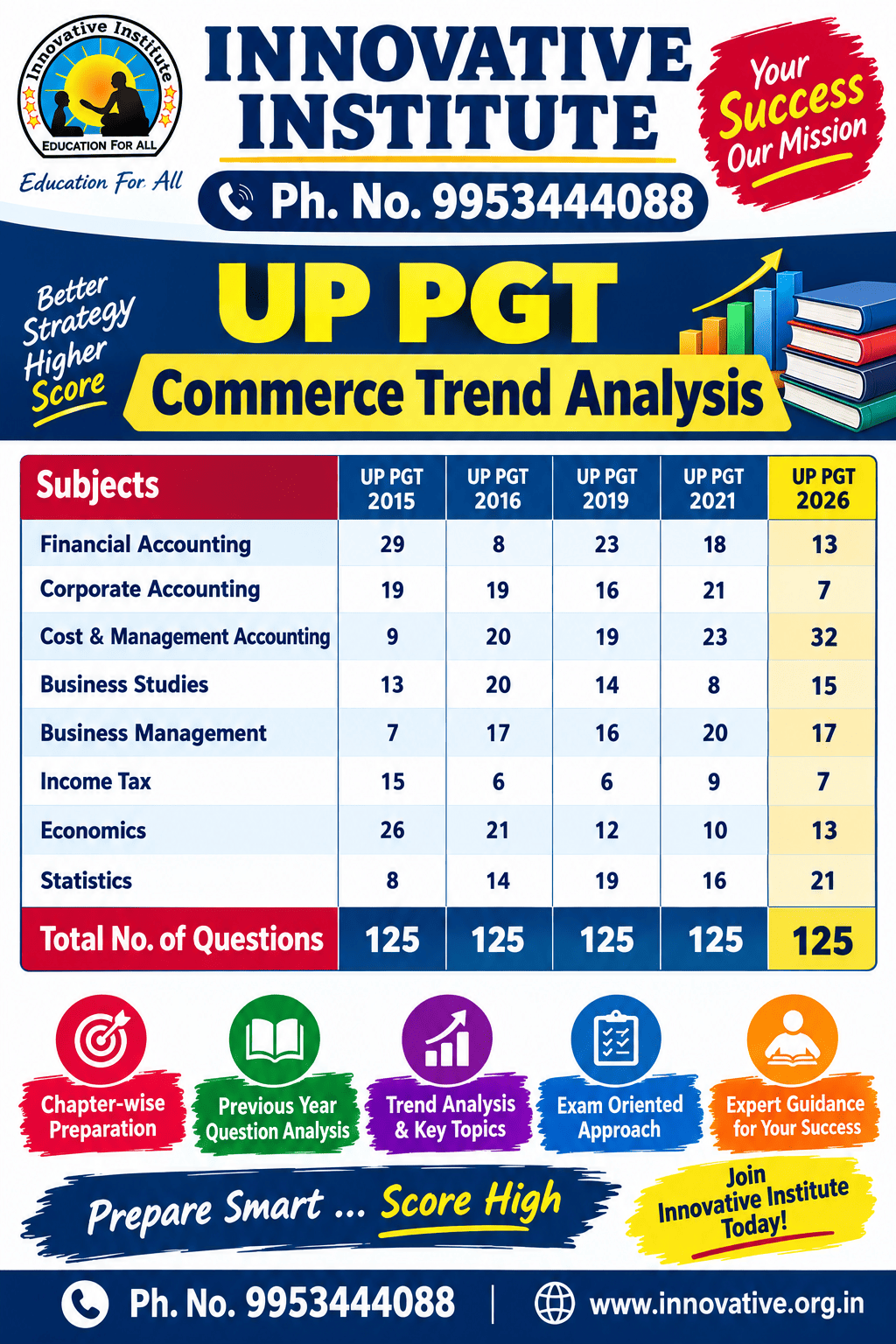
UP PGT Commerce Trend Analysis
| Subjects | UP PGT – 2015 | UP PGT – 2016 | UP PGT – 2019 | UP PGT – 2021 | UP PGT – 2026 |
| Financial Accounting | 29 | 8 | 23 | 18 | 13 |
| Corporate Accounting | 19 | 19 | 16 | 21 | 7 |
| Cost & Management Accounting | 9 | 20 | 19 | 23 | 32 |
| Business Studies | 13 | 20 | 14 | 8 | 15 |
| Business Management | 7 | 17 | 16 | 20 | 17 |
| Income Tax | 15 | 6 | 6 | 9 | 7 |
| Economics | 26 | 21 | 12 | 10 | 13 |
| Statistics | 8 | 14 | 19 | 16 | 21 |
| Total No. of Questions | 125 | 125 | 125 | 125 | 125 |
Financial Accounting
- In a partnership, profits are shared as per the deed. Which accounting concept governs this, and which ratio measures partners’ capital efficiency?
(a) Consistency Concept and Debt-Equity Ratio
(b) Agreement Concept and Return on Capital Employed (ROCE)
(c) Realisation Concept and Proprietary Ratio
(d) Entity Concept and Current Ratio - Sales is equal to
(a) Cost of goods sold + Gross profit
(b) Cost of goods sold – Gross profit
(c) Cost of goods sold – Net profit
(d) Gross profit – Cost of goods sold - Provision for doubtful debts is made in the final accounts. Which principle supports this, and which forecasting tool helps estimate future credit sales?
(a) Dual Aspect and Trend Percentage
(b) Realization and Time Series Analysis
(c) Consistency and Correlation
(d) Conservatism and Regression Analysis - While making the trading and profit and loss accounts
(a) Only real accounts are transferred to the trading and profit and loss accounts
(b) Only nominal accounts are transferred to the trading and profit and loss accounts
(c) Only nominal accounts and opening stocks are transferred to the trading and profit and loss accounts
(d) All nominal and real accounts are transferred to the trading and profit and loss accounts - What is an adjustment entry?
(a) An entry that corrects a mistake
(b) An entry made to bring accounts up to date
(c) An entry that is not recorded in the accounts
(d) An entry that cancels previous transactions - What is a partner’s capital account?
(a) An account showing drawings only
(b) An account reflecting a partner’s investment in the partnership
(c) An account for loans received by the partnership
(d) An account that records all expenses of a partner - Interest on capital in a partnership is
(a) An asset of the firm
(b) An appropriation of profit
(c) A charge against profit
(d) A liability always - Which of the following accounts normally carries a debit balance?
(a) Liability Account
(b) Asset Account
(c) Sales Account
(d) Capital Account - Which of the following measurement bases is consistent with the fair value concept?
(a) Historical cost and present value
(b) Current cost and realizable value
(c) Historical cost and realizable value
(d) Historical cost, current cost, and realizable value - Which of the following is correct?
(a) Assets = Capital – Liabilities
(b) Assets = Liabilities – Capital
(c) Assets = External Equities
(d) Assets = Liabilities + Capital - Ram has assets of Rs. 10,000 and liabilities of Rs. 2,000. His capital will be
(a) Rs. 8,000
(b) Rs. 10,000
(c) Rs. 2,000
(d) Rs. 12,000 - In the absence of partnership deed, interest on capital
(a) is allowed @ 6% per annum
(b) is not allowed
(c) is allowed at the borrowing rate
(d) is allowed @ 10% per annum - Arrange the following in the correct sequence of events in a partnership firm.
A. Preparation of Partner’s Capital Accounts.
B. Preparation of Profit and Loss Appropriation Account
C. Preparation of Profit and Loss Account.
D. Preparation of Balance Sheet.
Choose the most appropriate answer from the options given below:
(a) C, B, A, D
(b) A, B, C, D
(c) C, B, D, A
(d) B, A, D, C
Corporate Accounting
- Match List – I with List II.
List – I (Share Issue)
A. Shares issued at a premium
B. Shares issued at a discount
C. Redemption of debentures by conversion
D. Redemption of debentures by purchase in the open market
List – II (Terms and Conditions)
I. The company buys back its debentures before maturity
II. Issue at discount are restricted under the Companies Act, and allowed only in specific cases, like sweat equity
III. Premium is transferred to Securities Premium A/c
IV. Debentures converted into shares or new debentures
Choose the most appropriate answer from the options given below:
(a) A-III; B-II; C-I; D-IV
(b) A-I; B-II; C-III; D-IV
(c) A -III; B-II; C-IV; D-I
(d) A-I; B-II; C-IV; D-III - Debenture interest is paid
(a) at variable rate
(b) at a predetermined rate
(c) at a rate determined by company from time to time
(d) at a rate based on net profit of the company - Arrange the steps in the issuance of shares by a company.
A. Application money received
B. Allotment of shares
C. Issue of Prospectus/Invitation to the public
D. Receipt of call money
Choose the most appropriate answer from the options given below:
(a) B, A, D, C
(b) A, C, B, D
(c) C, A, B, D
(d) D, B, A, C - Which of the following is not a component of the financial statements for a company?
(a) Income Statement
(b) Sales Ledger
(c) Balance Sheet
(d) Cash Flow Statement - Share premium account and capital redemption reserve account are
(a) Capital reserve, but should be shown separately in the balance sheet
(b) Revenue reserve
(c) Capital reserve, so it should be included in the carrying amount of capital reserves
(d) Neither revenue reserve nor capital reserve, so it should be shown separately in the balance sheet - What will the right sequence of events for the forfeiture and re-issuance of shares?
A. Forfeiture of shares.
B. Default on calls.
C. Reissue of shares.
D. Amount transferred to Capital Reserve.
Choose the most appropriate answer from the options given below:
(a) B, D, A, C
(b) A, B, C, D
(c) C, B, D, A
(d) B, A, C, D - XYZ Ltd. issued a prospectus inviting applications for 2,000 shares. Applications were received 3,000 shares and a pro-rata allotment was made to the applicants of 2,400 shares. If Ram has been allotted 40 shares, how many shares he must have applied for?
(a) 44
(b) 40
(c) 48
(d) 46
Cost & Management Accounting
- The concept of marginal cost is closely related with
(a) Fixed cost
(b) Opportunity cost
(c) Economic cost
(d) Variable cost - Which of the following best describes the importance of managerial accounting?
(a) It supports management in planning, controlling, and decision-making
(b) It helps with tax planning and reporting
(c) It is primarily focused on external reporting
(d) It is limited to historical financial data - Fixed costs are defined as
(a) Costs are unchanged regardless of output
(b) Costs vary directly with output
(c) Costs fall to zero in the long run
(d) Costs rise faster than output - What is the primary objective of cost accounting?
(a) Record financial transactions
(b) Maximize profits
(c) Facilitate cost control and decision-making
(d) Provide financial statements - If the direct materials consumed are Rs. 30,000, direct labor is Rs.20,000, and factory overhead is Rs.15,000, what is the total manufacturing cost?
(a) Rs. 65,000.00
(b) Rs. 50,000.00
(c) Rs. 20,000.00
(d) Rs. 30,000.00 - The cost of an advertisement is generally classified as
(a) Selling and distribution overhead
(b) Direct expense
(c) Administrative overhead
(d) Production overhead - Revision of budgets is necessary when the original budget was prepared with
(a) Judgement of employees only
(b) Inappropriate data
(c) Only the advice of the audit committee
(d) Only management direction - Managerial reports are prepared mainly for
(a) General public
(b) Shareholders and government
(c) Internal management at different levels
(d) Creditors and banks only - A worker is allowed 60 hours to complete the job on a guaranteed wage of Rs. 10 per hour. Under the Rowan Plan, he gets an hourly wage of Rs. 12 per hour. For the same saving in time, how much will he get under the Halsey Plan?
(a) Rs. 540
(b) Rs. 720
(c) Rs. 900
(d) Rs. 600 - The sum of direct labour and factory overhead is termed
(a) Conversion cost
(b) Prime cost
(c) Direct cost
(d) Cost of goods manufactured - Unit or Output Costing is also known as
(a) Job Costing
(b) Process Costing
(c) Contract Costing
(d) Single Costing - Job costing is
(a) The method of costing used for non-standard and non-repetitive products
(b) Suitable where similar products are produced on a mass scale
(c) It is used regardless of any particular type of product
(d) Applicable to all industries regardless of the products or services produced - What is one of the primary functions of managerial accounting?
(a) Assessing corporate governance
(b) Preparing financial statements for shareholders
(c) Budget preparation and control
(d) Conducting external audits - In Contract Costing work certified represents
(a) Work completed and certified by the contractor architect
(b) Work completed but not approved by the contractor
(c) Work completed but awaiting payment
(d) Work has not yet started - Costs which are ascertained after they have been incurred are known as
(a) Imputed Costs
(b) Sunk costs
(c) Opportunity costs
(d) Historical costs - A performance report prepared in managerial accounting is primarily used for
(a) Assessing the profitability of the company for taxation
(b) Comparing actual performance with planned objectives
(c) Meeting statutory audit requirements
(d) Disclosure in the annual report - An escalation clause in a contract is used to
(a) Avoid penalties for delay
(b) Increase the contractor’s profit margin
(c) Safeguard the contractor against an increase in costs
(d) Reduce administrative overheads - The fixed-variable cost classification has a special significance in the preparation of
(a) Master budget
(b) Cash budget
(c) Capital budget
(d) Flexible budget - Which of the following is true about Contract Costing
(a) It is identical to Job Costing
(b) It ignores overheads
(c) It is used for standardized products
(d) It deals with large, non-repetitive, long-term contracts - Which principle explains the difference between profit transfer in contract costing and revenue recognition in financial accounting, and what is the objective of contract accounting?
(a) Dual Aspect and Cost Reduction
(b) Prudence Principle and Cost Control
(c) Realisation Principle and Ascertainment of Cost
(d) Matching Principle and Revenue Recognition - Sunk costs are
(a) Future costs
(b) Relevant for decision-making
(c) Not relevant for decision-making
(d) Cost to be incurred in the future - 42. Which one of the following is related to the calculation of labor turnover?
(a) Cost of utilities
(b) Replacement method
(c) Direct expenses
(d) Decision package - Arrange the following in the correct sequence of objectives of Cost Accounting.
A. Ascertainment of Cost.
B. Cost Control
C. Cost Reduction
D. Decision Making
Choose the most appropriate answer from the options given below.
(a) A, B, C, D
(b) A, C, B, D
(c) A, D, B, C
(d) B, A, C, D - Which of the following closely matches with Just In Time (JIT)?
(a) Cost of utilities
(b) Decision package
(c) Replacement method
(d) Production strategy - Arrange the following managerial reporting tools in the logical order of use.
A. Forecasting Tools
B. Regression Analysis
C. Ratio Analysis
D. Managerial Decision-Making
Choose the most appropriate answer from the options given below:
(a) B, A, C, D
(b) C, B, A, D
(c) A, C, B, D
(d) C, A, B, D - Management accounting deals with————– data.
(a) Quantitative
(b) Qualitative
(c) Only non-financial
(d) Both qualitative and quantitative - Which of the following budget should be prepared first?
(a) Master Budget
(b) Production Budget
(c) Sales Budget
(d) Purchase Budget - The sequence of steps in the process costing method is
A. Calculate the output
B. Measure the cost per unit
C. Record expense
D. Preparation of the report
Choose the most appropriate answer from the options given below.
(a) A, B, C, D
(b) A, C, B, D
(c) A, D, B, C
(d) C, A, B, D - Unit Costing is most suitable for
(a) Hospital services
(b) Construction industry
(c) Shipbuilding
(d) Cement manufacturing - Which of the following methods is used to allocate overhead costs based on the activities than consume resources?
(a) Direct Costing
(b) Traditional Costing
(c) Standard Costing
(d) Activity-Based Costing (ABC) - Usually the production budget is stated in terms of
(a) Quantity
(b) Money
(c) Both money and quantity
(d) Neither money nor quantity - In budgeting, what does a ‘master budget’ encompass?
(a) The comprehensive set of budgets including sales, production, and cash budgets
(b) Only the sales budget
(c) Only the cash flow budget
(d) The production budget alone
Business Studies
- Ramesh’s conduct leads others to believe he is a partner of ABC Associates. Identify the type of partner he represents.
(a) Sleeping Partner
(b) Active Partner
(c) Partner by Estoppel
(d) Secret Partner - Sudhanshu is an active partner in a firm with unlimited liability, optional registration, management rights and dissolution on a partner’s death/insolvency. What type of partnership is this?
(a) Partnership at will
(b) General Partnership
(c) Particular Partnership
(d) Limited Liability Partnership - Transfer of ownership is easy in the case of ————— whereas it is difficult in the case of —–
(a) Sole proprietorship, Joint Stock Company
(b) Joint-stock company, partnership
(c) Partnership, joint stock company
(d) Sole proprietorship, partnership - The leakage of which gas caused the Bhopal tragedy, a well-known industrial disaster?
(a) Potassium isothiocyanate
(b) Ethyl isocyanate
(c) Methyl isocyanate
(d) Sodium isothiocyanate - The three main components of foreign trade are
(a) Wholesale, Retail, Export
(b) Import, Export, Entrepot
(c) Domestic, International, Regional
(d) Trade, Industry, Commerce - Match List-I with List – II.
List-I (Document)
A. Bill of Lading
B. Letter of Credit
C. Certificate of Origin
D. Marine Insurance Policy
List – II (Purpose)
I. Evidence of shipment of goods by sea
II. Bank’s assurance of payment to the exporter
III. Certifies the country where the goods were produced
IV. Provides coverage against sea risks during shipment
Choose the most appropriate answer from the options given below:
(a) A – IV; B – II; C-III; D-I
(b) A – I; B-II; C-III; D-IV
(c) A – III; B-IV; C – I; D-II
(d) A – I; B – II; C-IV; D-III - When a business takes steps to protect the environment, it is primarily performing its responsibility towards
(a) Employees
(b) Customers
(c) Owners
(d) Society - Arun is doing a business activity in which he enjoys all the profits and bears all the risk alone. What type of organization do you think Arun is running?
(a) Sole Proprietorship
(b) Private Company
(c) Partnership
(d) Company - Which of the following is a demerit of a partnership firm?
(a) Dominance of one partner
(b) Unequal distribution of profit
(c) Limited managerial ability
(d) Unlimited liability - Arrange the following in the correct sequence of stages in the formation of a company.
A. Certificate of commencement.
B. Incorporation.
C. Capital Subscription.
D. Promotion.
Choose the most appropriate answer from the options given below:
(a) D, B, C, A
(b) A, B, C, D
(c) C, B, D, A
(d) B, A, D, C - Of the following organizations, the easiest to wind up is the
(a) Multinational corporation
(b) Public limited company
(c) Partnership firm
(d) Private limited company - Which economic activity deals with the use of goods and services for the satisfaction of human wants?
(a) Exchange
(b) Consumption
(c) Distribution
(d) Production - The source of the rules relating to the internal management of a company is known as
(a) Prospectus
(b) Memorandum of Association
(c) Fundamental rules
(d) Articles of Association - The primary objective of a business organization is best defined as
(a) Coordinating resources to meet human needs
(b) Maximizing short-term profits
(c) Fulfilling statutory obligations exclusively
(d) Creating employment opportunities alone. - The first 2 digits of the GSTIN are
(a) PAN of the legal entity
(b) Checksum number
(c) State code
(d) Entity code
Business Management
- Concentration of decision-making functions at the top of the management hierarchy is called
(a) Delegation
(b) Decentralization
(c) Centralization
(d) Organizational Structure - The obligation of a subordinate to properly perform the assigned duty is known as
(a) Responsibility
(b) Authority
(c) Delegation
(d) Accountability - A tall structure has
(a) No span of management
(b) A narrow span of management
(c) Wide span of management
(d) Informal organization - Controlling is performed at
(a) Middle level
(b) Top level
(c) At all the levels of management
(d) Supervisory level - Cross elasticity of complementary goods is
(a) High
(b) Negative
(c) Infinite
(d) Zero - The individuals who manage the work of first-line managers in an organization are
(a) Top managers
(b) Executive managers
(c) Non-managers
(d) Middle managers - The Scientific Management Theory was introduced by,
(a) Henry Fayol
(b) Elton Mayo
(c) F. W. Taylor
(d) Max Weber - The specific actions or behaviours expected of a manager are referred to as
(a) Functions
(b) Responsibilities
(c) Roles
(d) Skills - The Hawthorne studies by Elton Mayo emphasized the importance of
(a) Monetary incentives
(b) Division of labor
(c) Authority and discipline
(d) Human relations and social needs at work - Which of the following qualifies management as a profession?
(a) Dependence on heredity
(b) Absence of ethical codes
(c) Specialized knowledge and training
(d) Lack of accountability - Management’s status as a profession is debated because
(a) Entry is restricted by statutory bodies
(b) Managers require licenses to practice
(c) It does not require any knowledge base
(d) It lacks universally binding ethical codes and legal regulations - The function that establishes authority and responsibility to ensure coordination is
(a) Controlling
(b) Planning
(c) Organizing
(d) Motivating - Motivation in management is vital because it
(a) Reduces employee costs
(b) Aligns individual efforts with organizational goals
(c) Replaces the need for coordination
(d) Eliminates the need for supervision - A manager notices employees missing deadlines. He sets clear timelines, monitors progress, and imposes penalties. Which function is being applied?
(a) Planning
(b) Motivation
(c) Staffing
(d) Controlling - An IT team shows higher satisfaction and output when managers consider their needs and involve them in decisions. This reflects
(a) Human Relations Approach
(b) Scientific Management
(c) Classical Theory
(d) Bureaucratic Management - Sequence the motivational process in management.
A. Performance and Feedback
B. Goal Setting
C. Effort Application
D. Need Recognition
Choose the most appropriate answer from the options given below:
(a) B, A, C, D
(b) D, B, C, A
(c) C, A, B, D
(d) A, C, B, D - Sequence the evolution of management theories!
A. Administrative Theory
B. Human Relations Theory
C. Modern Systems Approach
D. Scientific Management
Choose the most appropriate answer from the options given below.
(a) A, B, C, D
(b) C, A, B, D
(c) C, B, D, A
(d) D, A, B, C
Income Tax
- What is defined as agricultural income?
(a) Income derived from the sale of agricultural machinery
(b) Income generated from any source associated with farming
(c) Income from horticulture and sericulture only
(d) Income earned from the sale of agricultural products and land cultivation - Tax liability refers to
(a) The amount of tax an individual is legally obligated to pay
(b) The total amount of income earned by an individual
(c) The tax rate applicable to different income tiers
(d) The amount of tax refunds due to the individual - Profit on sale of rural agricultural land is
(a) Not taxable under the head ‘Capital gains’ but under the head ‘Income from Other Source’.
(b) Not taxable as it is agricultural income.
(c) Not taxable as rural agricultural land is not considered as a capital asset.
(d) Taxable if it is compulsorily acquired. - Indirect taxes are –––––––– in nature.
(a) Regressive
(b) Progressive
(c) Neither progressive nor regressive
(d) Partly progressive and partly regressive - “Assessment year” refers to
(a) The year following the previous year, in which income is taxed
(b) The year in which income is earned
(c) The year ending on 31st December
(d) The year in which accounts are maintained - For income earned during the Previous Year 2024-25, the Assessment Year will be
(a) 2024-25
(b) 2023-24
(c) 2026-27
(d) 2025-26 - Agricultural income under the Income-tax Act, 1961, is
(a) Fully exempt in all cases
(b) Fully taxable in all cases
(c) Taxable as “Income from Other Sources”
(d) Exempt, but considered for rate purposes in certain cases
Business Economics
- Put into chronological order on the basis of development.
A. Law of demand
B. Law of indifference
C. Law of diminishing marginal utility
D. Indifference curve
Choose the most appropriate answer from the options given below:
(a) A, D, C, B
(b) A, B, C, D
(c) C, B, D, A
(d) A, C, B, D - Demand and supply theory helps businesses mainly in
(a) Forecasting consumer behavior
(b) Estimating tax liabilities
(c) Analyzing public debt
(d) Measuring GDP - The Marginal Rate of Substitution (MRS) on an indifference curve is generally
(a) Increases continuously.
(b) Remains constant
(c) Becomes infinite at all points
(d) Diminishes as one moves down the curve - The Law of Diminishing Returns applies when
(a) One input is increased while others remain fixed
(b) All inputs are increased simultaneously
(c) Technology rapidly improves
(d) Both labor and capital are reduced proportionately - A production function expresses
(a) Output value in monetary terms
(b) The technical relation between inputs and outputs
(c) Consumer preference patterns
(d) Distribution of income among factors - Which branch of economic theory deals with the allocation of resources?
(a) Micro-economics
(b) Macroeconomics
(c) Statistics
(d) Economic growth - The business cycle stage with rising demand, investment, and income is
(a) Stagnation
(b) Depression
(c) Recovery
(d) Contraction - Arrange the following stages in the chronological development of population theories
A. Causes of population growth
B. Effects of population growth
C. Malthusian theory
D. Optimum population theory
Choose the most appropriate answer from the options given below.
(a) B, C, D, A
(b) A, B, C, D
(c) C, A, B, D
(d) B, A, D, C - Arrange the following items in their correct sequential order to explain how economics relates to business.
A. Optimum Allocation
B. Business Decisions
C. Economic Principles
D. Scarcity of Resources
Choose the most appropriate answer from the options given below.
(a) B, A, C, D
(b) D, C, A, B
(c) C, B, D, A
(d) B, A, D, C - The welfare definition of economics is given by
(a) Adam Smith
(b) Lionell Robbins
(c) Prof. Samuelson
(d) Alfred Marshall - Industrial pollution is considered a form of market failure because
(a) It increases consumer surplus
(b) It reduces government revenues
(c) It stimulates innovation in green technology
(d) It generates external costs that are not reflected in market prices - Which of the following is one of the assumptions of the indifference curve analysis?
(a) Ordinal utility.
(b) Cardinal utility
(c) Constant marginal utility of money
(d) Independent utility - Which branch of economics examines the functioning of the economy as a whole?
(a) Macroeconomics
(b) Microeconomics
(c) Welfare Economics
(d) Managerial Economics
Statistics
- Arrange the given suggestions for improving Indian statistics in order of preference, from most to least.
A. International Comparability
B. Expansion of Coverage
C. Timely Publication
D. Adoption of Modern Techniques
Choose the most appropriate answer from the options given below:
(a) A, B, C, D
(b) D, B, C, A
(c) C, B, D, A
(d) B, A, D, C - Match List-I with List-II.
List-I (Concept) List – II (Description)
A. Statistics I. Array of data and tally bars
B. Production II. Techniques used for the collection, organization and presentation of data
C. Organization of data III. The process of converting raw materials into goods
D. Statistical tools IV. Quantification of facts and findings
Choose the most appropriate answer from the options given below:
(a) A –IV; B-III; C-I; D-II
(b) A- I; B-II; C-III; D-IV
(c) A-III; B-IV; C-I; D-II
(d) A-I; B-II; C-IV; D-III - Match List I with List – II.
List – I (Element)
A. Sources of Basic Data
B. Forecasting Tools
C. Principles
D. Analysis and use
List – II (Application/Principle)
I. Internal cost sheets, industry trends, government indices
II. Regression, moving averages, exponential smoothing
III. Forecasts must balance relevance, reliability and flexibility
IV. Supports capital budgeting, pricing and capacity planning
Choose the most appropriate answer from the options given below:
(a) A-I; B-III; C-II; D-IV
(b) A-I; B-II; C-III; D-IV
(c) A-III; B-IV; C-I; D-II
(d) A-I; B-II; C-IV; D-III - Base year is also known as
(a) Current year
(b) Reference year
(c) Both current year and periodic year
(d) Periodic year - The aggregate of data is called
(a) Analysis of data
(b) Editing of data
(c) Statistics
(d) Collection of data - Read the following statements carefully.
a. Data originally collected by an investigator for the first time for some specific purpose is known as secondary data.
b. The population census conducted by the Government of India is an example of secondary data.
Choose the most appropriate answer from the options given below:
(a) Both the statements are false
(b) Both the statements are true
(c) Statement a is false and statement b is true
(d) Statement a is true and statement b is false - When two variables change in constant proportion, it is called
(a) Non-linear correlation
(b) Linear correlation
(c) Partial or non-linear correlation
(d) Partial correlation - The primary purpose of constructing a frequency distribution is to
(a) Convert data into percentages only
(b) Increase sample size
(c) Summarize raw data into structured groups
(d) Eliminate outliers from the dataset - A company uses regression analysis to forecast sales based on advertising expenditure. Here, advertising expenditure is
(a) Independent variable
(b) Dependent variable
(c) Residual value
(d) Minimum value - The mid-point of a class interval in a frequency distribution is called
(a) Class width
(b) Class limit
(c) Class mark
(d) Class frequency - Which forecasting method combines regression analysis with time series to improve accuracy?
(a) Exponential smoothing
(b) Moving averages
(c) Delphi technique
(d) Econometric models - Which statistical tool is most suitable for analyzing categorical variables such as gender or occupation?
(a) Correlation coefficient
(b) Mean and Median
(c) Regression equation
(d) Chi-square test - The maximum value of rank correlation coefficient is
(a) +1
(b) 0
(c) Any natural number
(d) – 1 - Arrange the following steps of the regression flow chart analysis in the correct sequence.
A. Collection of data.
B. Identification of variables
C. Testing the significance
D. Estimation of the regression equation
Choose the most appropriate answer from the options given below:
(a) B, A, C, D
(b) A, B, C , D
(c) B, A, D, C
(d) A, C, B, D - The component of a time series that shows long-term upward or downward movement is called
(a) Seasonal variation
(b) Secular trend
(c) Irregular variation
(d) Cyclical fluctuation - The most suitable method for measuring seasonal variations in a time series is
(a) Moving average method
(b) Least squares method
(c) Correlation method
(d) Ratio-to-trend method - Personal bias is possible under
(a) Random sampling
(b) Systematic sampling
(c) Purposive sampling
(d) Stratified sampling - The difference between upper limit and lower limit of a class is known as
(a) Frequency
(b) Range
(c) Magnitude of a class interval
(d) Class limits - Match List – I with List – II.
List-I (Concept/Method)
A. Time Series Analysis
B. Business Forecasting
C. Coordinates
D. Principles of Forecasting
List – II (Explanation)
I. Study of data over intervals to identify trend, seasonal, cyclical, and irregular variations
II. Depends on the reliability of data, continuity of trends, and appropriate techniques
III. Graphical plotting of values along X and Y axes for functional relationships
IV. Predicting future events using historical and present data
Choose the most appropriate answer from the options given below:
(a) A-II; B-I; C-III; D-IV
(b) A-I; B-IV; C-III; D- II
(c) A-III; B-IV; C-I; D-II
(d) A-III; B-II; C-IV; D-I - Classification of data on the basis of
time period is called
(a) Chronological classification
(b) Geographical classification
(c) Quantitative classification
(d) Qualitative classification - Which one of the following is considered the most significant limitation of the Indian statistics?
(a) Over-dependence on modern technology
(b) Lack of periodic data collection
(c) Very low sample coverage in censuses
(d) Excessive private-sector involvement
UP PGT Commerce Books Complete Set of 7 Books –
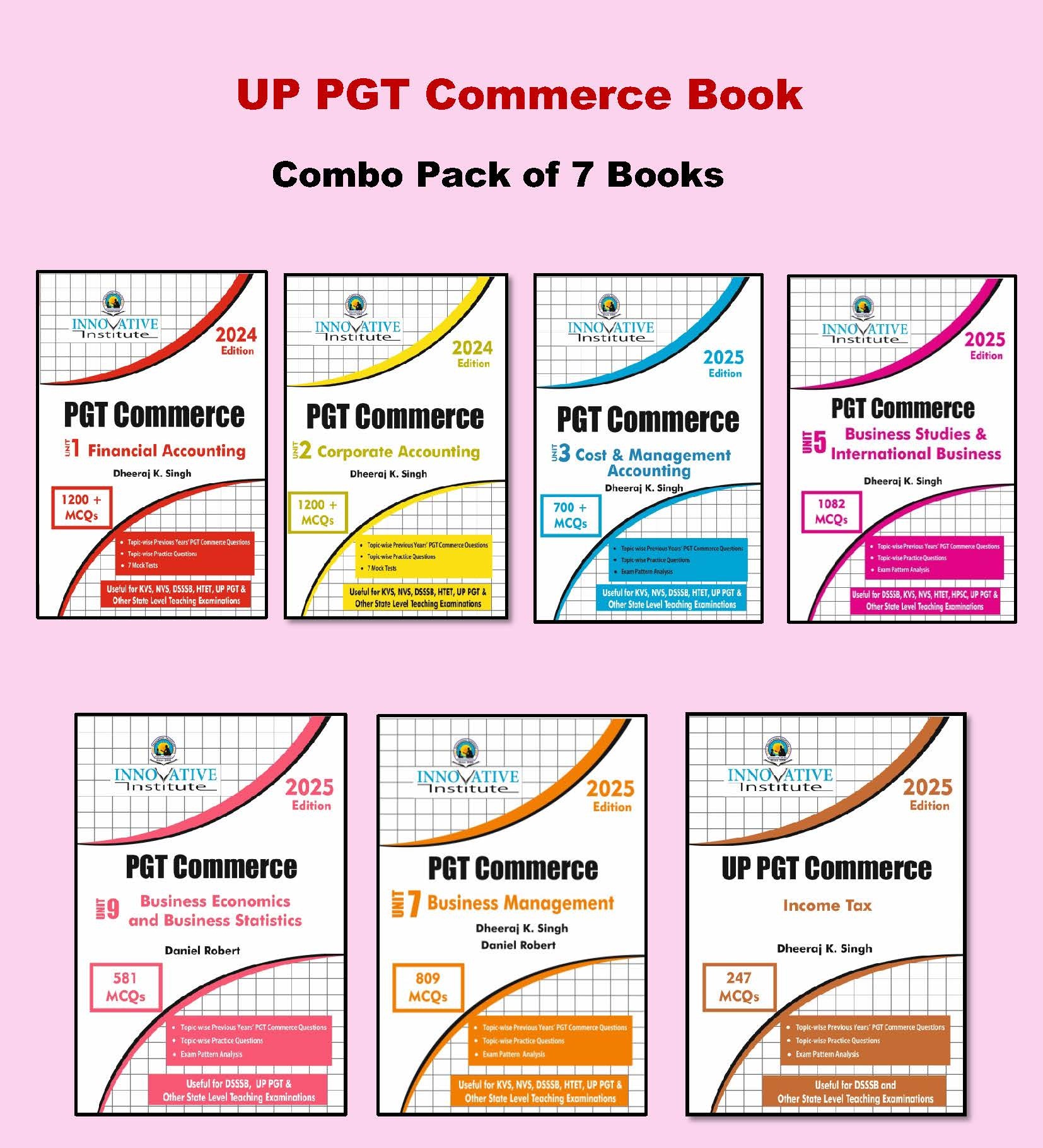
UP PGT Commerce Best Books for Preparation UP PGT Commerce Examination Published by Innovative Institute
UP PGT Commerce Books in English Medium By Dheeraj Kumar Singh | Best Book for UP PGT Commerce English Medium
| Section | Name of Book | Author | No . MCQs | No . of Pages |
| A |
Financial Accounting | Dheeraj Kumar Singh | 1503 | 274 |
| Corporate Accounting | Dheeraj Kumar Singh | 1202 | 250 | |
| Cost & Management Accounting | Dheeraj Kumar Singh | 704 | 178 | |
| Taxation | Dheeraj Kumar Singh | 247 | 116 | |
| B | Business Studies | Dheeraj Kumar Singh | 1006 | 302 |
| Business Management | Dheeraj Kumar Singh & Daniel Robert | |||
| C | Economics & Statistics | Daniel Robert | 581 | 218 |
UP PGT Commerce Question Pattern Analysis
| Subjects | UP PGT – 2015 | UP PGT – 2016 | UP PGT – 2019 | UP PGT – 2021 | UP PGT – 2026 |
| Financial Accounting | 29 | 8 | 23 | 18 | 13 |
| Corporate Accounting | 19 | 19 | 16 | 21 | 7 |
| Cost & Management Accounting | 9 | 20 | 19 | 23 | 32 |
| Business Studies | 13 | 20 | 14 | 8 | 15 |
| Business Management | 7 | 17 | 16 | 20 | 17 |
| Income Tax | 15 | 6 | 6 | 9 | 7 |
| Economics | 26 | 21 | 12 | 10 | 13 |
| Statistics | 8 | 14 | 19 | 16 | 21 |
| Total No. of Questions | 125 | 125 | 125 | 125 | 125 |
Financial Accounting
Corporate Accounting
Cost & Management Accounting
Income Tax
Business Studies & International Business
Business Management
Business Economics & Statistics
Buy the e-book on our App for instant access. Download the App using the link. : Link