
Punjab Lecturer Commerce online Coaching
What We Provide to Our Students
- Live Interactive Classes
- Recorded video lectures of the same sessions for revision anytime
- Study Material
- Printed Books delivered to your home
- E-Books (B-Books) available on the app for easy access
- Subject-wise Tests
- Regular tests for each subject to track progress and improve performance
Official Syllabus 2026: Link
Revised Answer Key Punjab Lecturer 2021 Examinations: Link
Question Paper Commerce 2016 : Link
Revised Answer Key Punjab Lecturer 2016 Examinations: Link
Punjab Lecturer Commerce Books
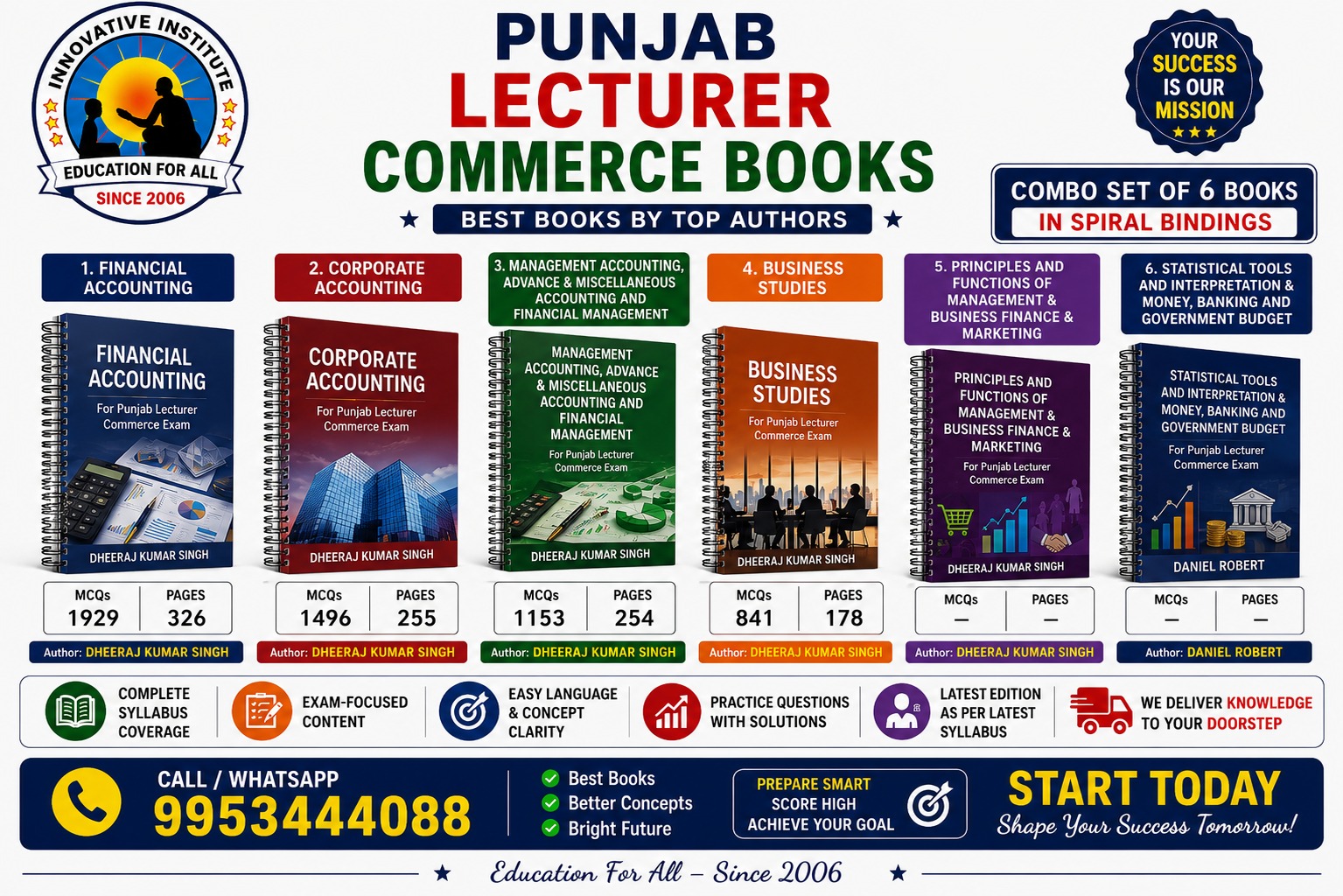
Combo Set of 6 Books in Spiral Bindings
| S. No | Books | Author | No. of MCQs | No. of Pages |
| 1 | Financial Accounting | Dheeraj Kumar Singh | 1942 | 326 |
| 2 | Corporate Accounting | Dheeraj Kumar Singh | 1496 | 255 |
| 3 |
Management Accounting | Dheeraj Kumar Singh | 377 | 76 |
| Advance & Miscellaneous Accounting | Dheeraj Kumar Singh | 373 | 84 | |
| Financial Management | Dheeraj Kumar Singh | 403 | 94 | |
| 4 | Business Studies | Dheeraj Kumar Singh | 881 | 178 |
| 5 |
Principles and Functions of Management | Dheeraj Kumar Singh | 1108 | 214 |
| Marketing | Dheeraj Kumar Singh | 405 | 96 | |
| 6 |
Statistical Tools and Interpretation | Daniel Robert | 264 | 86 |
| Money, Banking and Government Budget | Daniel Robert | 168 | 58 | |
| Total |
7417 | 1467 | ||
Punjab Lecturer – Financial Accounting
Punjab Lecturer – Corporate Accounting
Punjab Lecturer – Management Accounting
Punjab Lecturer – Miscellaneous Accounting
Punjab Lecturer – Financial Management
Punjab Lecturer – Business Studies
Punjab Lecturer – Principles and Functions of Management
Punjab Lecturer – Marketing Management
Punjab Lecturer – Statistical Tools and Interpretation
Punjab Lecturer – Money, Banking and Government Budget
Printed Book Price : Rs. 3,500
E- Book Price On APP : Rs. 1,000
Buy the e-book on our App for instant access. Download the App using the link. : Link
“First, read the sample content on our app. Then purchase the full content. The validity of the content is one year from the date of purchase.”
“Payment for the e-book is accepted via PhonePe, GPay, or Paytm at 9717168088.”
“After making the payment, please send your name, email ID, and phone number to WhatsApp number 9953444088 to receive access on the app.”
**Benefits of Purchasing Books on App**
📚 Always Updated Content : Our books are regularly updated, ensuring you always have access to the latest and most relevant study material directly on the app.
📱 Learn Anytime, Anywhere : Read conveniently on your mobile phone—whether you’re traveling, relaxing at home, or even lying in bed. Your learning goes wherever you go.
💰 Cost-Effective Option : Digital books are more affordable than printed versions, helping you save money without compromising on quality.
✨ Smart Choice for Modern Learning : With updated content, flexibility, and affordability, app-based books are the perfect companion for today’s learners.
Punjab Lecturer Commerce Question Paper– 2021 Analysis
| S. No | Subject | No. of MCQs | S. No | Subject | No. of MCQs | |
| 1 | ACCOUNTING: | 25 | 2 | BUSINESS STUDIES | 77 | |
| Financial Accounting | 11 | |||||
| Corporate Accounting | 8 | |||||
| Cost & Management Accounting | 6 | |||||
| 3 | STATISTICS | 25 | 4 | ECONOMICS | 23 | |
| Total No. of Commerce Subject Questions = 150 |
||||||
ACCOUNTING:
Financial Accounting
- Errors of duplication are errors of ———
(a) Commission
(b) Omission
(c) Principles
(d) None of these - ————— is disclosed by trial balance.
(a) Wrong posting in ledger accounts
(b) Errors of omission
(c) Errors of principle
(d) Non-recording of an entry in original books - –––––––––– is generally not shown in trial balance.
(a) Cash in hand
(b) Opening stock
(c) Closing stock
(d) Fixture & Furniture - Distribution of premium for goodwill brought in by new partner is done on basis of ———-
(a) New profit sharing ratio
(b) Old profit sharing ratio
(c) Sacrificing ratio
(d) None of these - Comparison of one accounting period with that of the past is done by following ——— concept.
(a) Consistency
(b) Going concern
(c) Cost
(d) Time period - Accounting Standard———— deals with Depreciation Accounting.
(a) 3
(b) 2
(c) 6
(d) 8 - The accounting equation ‘asset = capital + liability’ is part of which of the following concepts?
(a) Going concern concept
(b) Realization concept
(c) Dual Aspect concept
(d) Materiality concept - The concept that recognizes the distinction between the receipt of cash and the right to receive the cash is called
(a) Cash concept
(b) Accrual concept
(c) Materiality concept
(d) None of these - Mr. Ramesh carrying on real estate business sold a piece of land for Rs.10,00,000 (cost Rs.3,80,000) the type of receipt is—————– in nature and profit on sale is
(a) Capital, transferred to P& L A/c
(b) Revenue, transferred to General Reserve
(c) Capital, transferred to capital reserve
(d) Revenue, transferred to P & L A/c - Amount spent for increasing the earning capacity is a —————– expenditure.
(a) Revenue
(b) Deferred revenue
(c) Capital
(d) Capital Loss - Which of the following expenditures is not a capital expenditure?
(a) Purchase of Machinery
(b) Purchase of copyright
(c) Cost of Issue of shares
(d) Premium on Insurance of machinery
Corporate Accounting
- For issue of bonus shares, which of the following reserve cannot be used for the purpose:
(a) Dividend Equalisation reserve
(b) Capital redemption reserve
(c) Capital reserve arising due to revaluation
(d) Profit and Loss account - More than ————– shares of another company should be acquired to become a holding company.
(a) 49%,
(b) 50%
(c) 25%
(d) None of these - The financial year of holding and subsidiary company must be —————
(a) Different
(b) Same
(c) Either same or different
(d) None of these - Realisation account is opened in the books of transferor company and following assets are transferred
(a) Underwriting commission
(b) Discount on issue of Debentures
(c) Profit & Loss A/c (Dr.)
(d) None of these - While calculating purchase consideration ———— of the asset is to be considered.
(a) Market price
(b) Fair value
(c) Average price
(d) Book value - Pre- acquisition dividend received by holding company is credited to ————
(a) Investment A/c
(b) Profit & Loss A/c
(c) Capital profit
(d) None of these - Solvency of an organization depends on –––––––
(a) Management Efficiency
(b) Recovery of bad debts
(c) Paying capacity of short term debt
(d) Paying capacity of long term debts - The most precise test of liquidity is ——
(a) Quick Ratio
(b) Absolute Liquid Test Ratio
(c) Current Ratio
(d) None of these
Cost & Management Accounting
- An incremental budget is a budget that ——–.
(a) Excludes fixed costs
(b) Is based on previous year, adjusted for known changes
(c) Is prepared from the very beginning
(d) Breaks even - The scarce factor is also known as ———
(a) Abnormal factor
(b) Key factor
(c) Linking factor
(d) None of these - An example of long period budget is—–
(a) Production Budget
(b) Master Budget
(c) R & D Budget
(d) Sales Budget - The standards that require peak efficiency and do not allow any work interruptions are known as
(a) Ideal Standards
(b) Practical Standards
(c) Normal Standards
(d) Budgeted Standards - Which of the following cannot be a reason of unfavourable direct materials price variance?
(a) Quality of material purchased
(b) Inefficient standard setting
(c) Sudden rise in material price
(d) Appointing inexperienced workers - It is easy to distinguish variances as controllable and uncontrollable. The statement is ——-
(a) Partially true
(b) Partially False
(c) True
(d) False
BUSINESS STUDIES
- The principle of caveat emptor implies —————–.
(a) Let the Seller Beware
(b) Let the Government Beware
(c) Let the Buyer Beware
(d) All of these - Which of the following is NOT an environmental problem?
(a) Ozone Depletion
(b) Global Warming
(c) Water Pollution
(d) None of these - Producing goods and services, that society wants and selling them at a profit is an example of ——————.
(a) Economic Responsibility
(b) Legal Responsibility
(c) Ethical Responsibility
(d) Discretionary Responsibility - ——– refers to a form of business organization that is owned, managed and controlled by an individual who is the recipient of all profits and bearer of all risks.
(a) Sole proprietorship
(b) Partnership
(c) Joint Hindu Business
(d) Co-operative Societies - Joint Hindu Family business is governed by ——————.
(a) Companies Act, 1956
(b) Companies Act, 2013
(c) Hindu Succession Act, 1956
(d) None of these - The liability of Karta in Joint Hindu Family business is—————.
(a) Limited
(b) Unlimited
(c) Joint
(d) Depends on the Agreement - The partnership form of business organization is governed by the ———–
(a) Indian Companies Act, 2013
(b) Indian Partnership Act, 1930
(c) Indian Partnership Act, 1932
(d) None of these - According to section 464 of the Companies Act 2013, maximum number of partners in a partnership firm can be ——–.
(a) 10
(b) 20
(c) 200
(d) 100 - Mr. A allows the use of his name by XYZ firm, but does not contribute to its capital. He does not take active part in managing the firm, does not share its profit or losses but is liable, like other partners, to the third parties, for the repayments of the firm’s debts. Mr. A is a/an —————-.
(a) Active Partner
(b) Sleeping Partner
(c) Secret Partner
(d) Nominal Partner - The cooperative society is compulsorily required to get itself registered under the ————-
(a) Cooperatives Societies Act, 1912
(b) Cooperatives Societies Act, 1913
(c) Cooperatives Societies Act, 1915
(d) None of these - The management and control of the affairs of the company is undertaken by the —————
(a) Shareholders
(b) Members
(c) Board of Directors
(d) Promoters - The maximum number of members in a private company is restricted to————
(a) 50
(b) 100
(c) 150
(d) 200 - A public company needs to have a minimum of ————– directors.
(a) Two
(b) Three
(c) Four
(d) Five - A private limited company can start business as soon as it receives the ——–
(a) Certificate of Incorporation
(b) Certificate of Commencement
(c) Certificate of Continuation
(d) None of these - Which of the following is NOT a characteristic of company form of organization?
(a) Separate Legal Entity
(b) Perpetual Succession
(c) Unlimited Liability
(d) Common Seal - Railways & Post and Telegraph department are examples of —————-
(a) Departmental Undertakings
(b) Statutory Corporation
(c) Government Company
(d) All of these - A government company means any company in which not less than————of the paid up capital is held by the central government, or by any state government or partly by Central government and partly by one or more State governments and includes a company which is a subsidiary of a government company,
(a) 49 percent
(b) 51 percent
(c) 26 percent
(d) 74 percent - The branches of global enterprises are also known as
(a) Majority Owned Foreign Associates
(b) Majorly Owned Foreign Associates
(c) Majority Owned Foreign Affiliates
(d) None of these - ———————– are public enterprises brought into existence by a Special Act of the Parliament.
(a) Departmental Undertakings
(b) Statutory Corporations
(c) Government Company
(d) All of these - BIFR stands for ———————–.
(a) Board for Indian Financial Recovery
(b) Board for Industrial and Financial Reconstruction
(c) Board for Indian Financial Reconstruction
(d) None of these - —————– involves the sale of the equity shares to the private sector and the public.
(a) Disinvestment
(b) Investment
(c) Private placement
(d) None of these - The shares of the government company are purchased in the name of the———–
(a) State Government
(b) Central Government
(c) President of India
(d) None of these - India follows _______economy.
(a) Capitalist
(b) Socialist
(c) Mixed
(d) None of these - Private sector consists of——————
(a) Sole Proprietorship
(b) Partnership
(c) Joint Hindu Family
(d) All of these - MoU in business stands for—————–
(a) Memorandum of Understanding
(b) Memorandum of Undertaking
(c) Memorandum of Underwriting
(d) None of these - Which of the following statements is INCORRECT with respect to Departmental Undertakings?
(a) These enterprises are established as departments of the ministry and are considered part or an extension of the ministry itself.
(b) The Government functions through these departments and the activities performed by them are an integral part of the functioning of the government,
(c) They act through the officers of the Government and its employees are Government employees.
(d) They have been constituted as autonomous or independent institutions and as such are independent legal entities. - A government company has —————-
(a) Memorandum of Association
(b) Articles of Association
(c) Both (a) and (b)
(d) None of these - Employment generation form part of which business objective?
(a) Economic Objectives
(b) Social Objectives
(c) Both (a) and (b)
(d) None of these - Which of the following industries is associated with converting raw material into finishing product?
(a) Primary Industry
(b) Secondary Industry
(c) Tertiary Industry
(d) All of these - Which of the following form part of aids to trade?
(a) Banking and Insurance
(b) Warehousing
(c) Insurance
(d) All of these - An economic activity is an activity that gives a —————
(a) Monetary Return
(b) Significant Return
(c) Windfall Gain
(d) Gain - ——————— requires special skills and knowledge to be applied by individuals in their respective occupations.
(a) Profession
(b) Business
(c) Employment
(d) None of these - In case of employment, the capital required is
(a) Limited
(b) Nil
(c) Dependent on the Scale of Operations
(d) None of these - ——————- are the risks for which no protection is available.
(a) Insurable Risks
(b) Non-insurable Risks
(c) Monetary Risks
(d) None of these - Mr. X is an employee in ABC Company. He leaked a secret of the company to the competitor resulting in huge losses to the ABC Company. This is an example of risk arising due to ——– causes.
(a) Economic
(b) Natural
(c) Human
(d) Physical - An earthquake occurring in the region damaged the factory outlet of XYZ Company. This is an example of risk arising due to ———– causes.
(a) Natural
(b) Economic
(c) Human
(d) None of these - Which of the following is NOT a characteristic of business?
(a) Profit Earning
(b) Economic Activity
(c) Sale or Exchange of Goods and Services
(d) Certainty of Returns - Which of the following is NOT an example of primary industry?
(a) Farming
(b) Mining
(c) Fishing
(d) Construction of Roads - Which of the following industry is concerned with providing services that help in smooth flow of goods & services?
(a) Primary Industry
(b) Secondary Industry
(c) Tertiary Industry
(d) All of these - ———- involves converting information into some special code.
(a) Encryption
(b) Decryption
(c) Both (a) and (b)
(d) Neither (a) nor (b) - EDI stands for ————–
(a) Electronic Data Interchange
(b) Electric Data Interchange
(c) Electronic Digital Interface
(d) Electronic Digital Interchange - Which of the following is NOT a threat to e-commerce?
(a) Hacking
(b) Viruses
(c) Dishonest Trading
(d) Digital Signatures - Which of the following statements is NOT TRUE with regard to e-commerce?
(a) A customer can get information about a product to be purchased on the Internet.
(b) A customer can place an order on the Internet.
(c) Payment cannot be made over the internet.
(d) E-commerce involves both online distribution and physical delivery. - Which of the following resources are not required for successful implementation of e-commerce?
(a) Computer System
(b) Internet Connection
(c) Technically Qualified Workforce
(d) None of these - ATM stands for
(a) Any Time Money
(b) Automated Teller Mechanism
(c) Automated Teller Machine
(d) None of these - Amazon is an example of which type of e-commerce?
(a) B2B
(b) B2C
(c) B2G
(d) C2C - OLX is an example of which type of e-commerce?
(a) B2B
(b) B2C
(c) B2G
(d) C2C - —————– involves outsourcing internal business functions like billing.
(a) Back Office Outsourcing
(b) Front Office Outsourcing
(c) Offshore Outsourcing
(d) Onshore Outsourcing - What is the full form of ITES?
(a) Information Technology Enabled Services
(b) Information Technology Empanelled Services
(c) Information Technology Empowered Services
(d) None of these - Which of the following is NOT an example of outsourcing?
(a) A company entering into contract with a third party for delegating its sanitation and housekeeping functions.
(b) A school tying up with some computer training institute to impart computer education to its students.
(c) A company delegating activities related to recruitment, selection, training etc., to third party service providers.
(d) None of these - Outsourcing enables a company to concentrate on its —————– activities by contracting out ————– activities to outsiders.
(a) Core, Non-core
(b) Non-core, Core
(c) Non-core, Routine
(d) Core, Critical - ———— is the rate of interest that a bank offers to its depositors.
(a) Lending Rate
(b) Borrowing Rate
(c) Both (a) and (b)
(d) Neither (a) nor (b) - Cash credit is classified under which function of commercial banks?
(a) Primary Functions
(b) Secondary Functions
(c) Both (a) and (b)
(d) Neither (a) nor (b) - HDFC Bank is which type of a bank?
(a) Public Limited Public Sector Bank
(b) Public Limited Private Sector Bank
(c) Private Limited Private Sector bank
(d) None of these - Overdraft is a facility in which the bank allows the ———————– account holders to overdraw their accounts by a specified limit.
(a) Fixed
(b) Salary
(c) Saving
(d) Current - In this type of life insurance policy, the amount is paid in regular instalments (rather than in lump sum) once the policy gets matured.
(a) Whole Life Assurance
(b) Term Life Assurance
(c) Annuity
(d) All of these - Mr. A took a health insurance policy. When he purchased the policy, he used to chew tobacco. Which principle of insurance was violated in the given situation?
(a) Principle of Proximate cause
(b) Principle of Insurable interest
(c) Principle of Utmost Good Faith
(d) Principle of Indemnity - According to……………………., after the insured has been compensated by the insurer for the loss suffered by him on the subject matter that was insured, the rights of the ownership of that Property goes to the insurer.
(a) Principle of Indemnity
(b) Principle of Loss Minimization
(c) Principle of Contribution
(d) Principle of Subrogation - _____ states that the insured should be compensated for the amount equal to the actual loss and not the amount exceeding the loss.
(a) Principle of Indemnity
(b) Principle of Loss Minimization
(c) Principle of Contribution
(d) Principle of Subrogation - ——– are owned and operated by big manufacturers and merchants to fulfill their own storage needs.
(a) Private Warehouses
(b) Public Warehouses
(c) Bonded Warehouses
(d) None of these - —————— are licensed by the government to accept imported goods for storage until the payment of custom duty.
(a) Private Warehouses
(b) Public Warehouses
(c) Bonded Warehouses
(d) None of these - Warehousing helps in creating———– utility.
(a) Time
(b) Place
(c) Both (a) and (b)
(d) Neither (a) nor (b) - —————- is a business insurance product that provides protection against business losses caused due to employee dishonesty, theft or fraud.
(a) Life Insurance
(b) Fire Insurance
(c) Marine Insurance
(d) Fidelity Insurance - Respecting the religious sentiments and dignity of people while advertising for a product is
(a) Economic Responsibility
(b) Legal Responsibility
(c) Ethical Responsibility
(d) Discretionary Responsibility - A company helping the affected people during floods or earthquakes is an example of
(a) Economic Responsibility
(b) Legal Responsibility
(c) Ethical Responsibility
(d) Discretionary Responsibility - Which of the following is NOT an element of business ethics?
(a) Top Management Commitment
(b) Publication of a ‘Code’
(c) Establishment of Compliance Mechanism
(d) Involving Top Level Employees Only - The Environment Protection Act was passed in which year?
(a) 1986
(b) 1974
(c) 1972
(d) 1988 - In India, the concept of CSR is governed by ——— of the Companies Act, 2013.
(a) Clause 125
(b) Clause 135
(c) Clause 140
(d) Clause 145 - The Companies Act, 2013 encourages companies to spend —————- of their average net profit in the previous three years on CSR activities.
(a) 1 percent
(b) 1.5 percent
(c) 2 percent
(d) 2.5 percent - The CSR provisions within the Act is applicable to companies with an annual turnover of ———— and more, or a net worth of Rs. 500 crore and more, or a net profit of Rs. 5 crore and more.
(a) Rs. 1000 crore
(b) Rs. 1500 crore
(c) Rs. 2000 crore
(d) Rs. 2500 crore - Which of the following is NOT an example of socially desirable practices?
(a) Supplying Good Quality Products
(b) Tax planning
(c) Sincerely Attending to Customer Complaints
(d) Exploiting Workers - Social responsibility involves an element of ——————- action on the part of business people for the benefit of society.
(a) Compulsory
(b) Voluntary
(c) Legal
(d) None of these
Money and Banking:
- ————— refers to a certain percentage of total deposits the commercial banks are required to maintain in the form of reserve with the central bank.
(a) Statutory Liquidity Ratio
(b) Cash Reserve Ratio
(c) Monetary Ratio
(d) None of the above - Dena and Vijaya Bank were merged with ————— with effect from April 1, 2019.
(a) Punjab National Bank
(b) Canara Bank
(c) Union Bank of India
(d) Bank of Baroda
Government budget and Economy:
- Capital expenditure of the government is that expenditure which —————
(a) Does not create any asset for the government Punjab
(b) Does not cause any reduction in liabilities of the government
(c) Creates assets for the government
(d) None of these - —————— is equal to the excess of total expenditure over the sum of revenue receipts and capital receipts excluding borrowing.
(a) Revenue Deficit
(b) Primary Deficit
(c) Fiscal Deficit
(d) None of these - Borrowings, recovery of loans and receipts from disinvestment by government are classified as ———–
(a) Revenue Receipts
(b) Capital Receipts
(c) Both (a) and (b)
(d) Neither (a) nor (b)
STATISTICS
- Data collected in a population census by the Office of the Registrar General and Census Commissioner is classified as
(a) Primary Data
(b) Secondary Data
(c) Both (a) and (b)
(d) Neither (a) nor (b) - Under this method of collecting primary data, the investigator contacts third parties called witnesses capable of supplying the necessary information. This method is called ————–
(a) Direct Personal Interviews
(b) Indirect Oral Interviews
(c) Mailed Questionnaire Method
(d) None of these - When questionnaires are constructed with the idea that the objective is clear to the respondents, such questionnaires are called
(a) Non-disguised
(b) Disguised
(c) Both (a) and (b)
(d) Neither (a) nor (b) - Which of the following is NOT a method of non-probability sampling?
(a) Judgment Sampling
(b) Convenience Sampling
(c) Quota Sampling
(d) Cluster Sampling - —————- are those methods of sampling in which each and every item in the universe has a known chance of being chosen in the sample.
(a) Non-probability Sampling Methods
(b) Probability Sampling Methods
(c) Judgment Sampling Methods
(d) Convenience Sampling Methods - Under this method of sampling, a sample is formed by selecting one unit at random and then selecting additional units at evenly spaced intervals until the sample has been formed.
(a) Simple Random Sampling
(b) Stratified Sampling
(c) Systematic Sampling
(d) Quota Sampling - ——————– occurs because the particular sample selected is an imperfect representation of the population of interest.
(a) Random Sampling Error
(b) Non-sampling Error
(c) Response Error
(d) Non-Response Error - ————– is that value in a series that occurs with the greatest frequency.
(a) Mean
(b) Median
(c) Mode
(d) Standard Deviation - The values which divide an ordered data set into ten equal parts are called ———.
(a) Quartiles
(b) Deciles
(c) Percentiles
(d) None of these - ————- is used where we want to compare the variability of two or more than two series.
(a) Range
(b) Quartile Deviation
(c) Standard Deviation
(d) Coefficient of Variation - In positively skewed distribution, the value of mean ————-.
(a) Is Maximum
(b) Is Minimum
(c) Lies Between Mode and Median
(d) Cannot be Determined - Skewness tells us about the —————- of variation
(a) Amount
(b) Direction
(c) Magnitude
(d) None of these - What is the formula for calculating Karl Pearson’s Coefficient of Skewness?
(a) Skp = (Median -Mean)/(Standard Deviation)
(b) Skp = ( Mean – Median)/(Coefficient of Variation )
(c) Skp = (Median -Moad)/(Standard Deviation)
(d) None of these - In symmetrical distribution, the values of mean, median and mode —————-.
(a) Coincide
(b) Vary
(c) Can coincide or vary
(d) Cannot be determined - What is the formula for calculating Kelly’s coefficient of Skewness?
(a) Skk = (P90+ P10 – 2 Median)/(P90+ P10 )
(b) Skk = (D9+ D1 – 2 D5)/(D9– D1 )
(c) Both (a) and (b)
(d) None of these - If both the variables in a data set are varying in the same direction, correlation between the variables is said to be ——-.
(a) Positive
(b) Negative
(c) Zero
(d) Cannot be determined - If the amount of change in one variable does not bear a current ratio to the amount of change in the other variable, correlation would be called —————-
(a) Linear Correlation
(b) Non-linear Correlation
(c) Both (a) and (b)
(d) Neither (a) nor (b) - Which of the following is NOT an assumption of Karl Pearson’s Coefficient of Correlation?
(a) There is linear relationship between the variables under study.
(b) There is a cause and effect relationship between the forces affecting the distribution of the items in the two series.
(c) The variables under study need not be normally distributed.
(d) None of these - Laspeyre’s index measures change in a ______ of goods and services.
(a) Fixed Market Basket
(b) Variable Market Basket
(c) Both (a) and (b)
(d) Neither (a) nor (b) - Consumer price index is also known as –––––––––––
(a) Wholesale Price Index
(b) Cost of Living Index
(c) Index of Industrial Production
(d) None of these - Which of the following is an example of continuous variable?
(a) Number of machines in a factory
(b) Number of rooms in a house
(c) Height
(d) None of these - When the class intervals are so fixed that the upper limit of one class is the lower limit of the next class, it is known as the –––––––––––––––––
(a) Inclusive Method of Classification
(b) Exclusive Method of Classification
(c) Both (a) and (b)
(d) Neither (a) nor (b) - The median is the ———— percentile value.
(a) 5th
(b) 10th
(c) 25th
(d) 50th - Chi-square is a———— test.
(a) Parametric
(b) Non-parametric
(c) Both (a) and (b)
(d) Neither (a) nor (b) - ——————– is used to find out whether the two samples may be regarded as drawn from the normal populations having the same variance.
(a) T-test
(b) Chi-square Test
(c) F-test
(d) None of these
ECONOMICS
- —————– is the study of Day of a national economy as a whole.
(a) Microeconomics
(b) Macroeconomics
(c) Both (a) and (b)
(d) Neither (a) nor (b) - Which of the following is NOT a central problem of an economy?
(a) What to Produce
(b) How to Produce
(c) Where to Produce
(d) For Whom to Produce - The value of the next best alternative to any decision you make is called ———–
(a) Production Possibility Frontier
(b) Opportunity Cost
(c) Efficiency Cost
(d) None of these - The additional benefit, which a person derives from a given stock of a thing, reduces with every increase in the stock that he already has. This law is called —.
(a) Law of Diminishing Marginal Utility
(b) Law of Equi-Marginal Utility
(c) Law of Demand
(d) Law of Supply - Which of the following is NOT a property of Indifference Curve?
(a) An indifference curve has a negative slope.
(b) Two indifference curves never cut each other.
(c) Higher indifference curve represents lesser satisfaction
(d) Indifference curve touches neither X-axis nor Y-axis. - ————- shows the combination of goods that can be purchased if the entire money income is spent.
(a) Budget Line
(b) Consumption Possibility Line
(c) Line of Attainable Combinations
(d) All of these - One of the conditions of consumer’s equilibrium is
(a) Price line should not be tangent to indifference curve.
(b) Price line should be tangent to budget line.
(c) Indifference curve should be convex to the point of origin.
(d) Indifference curve should be concave to the point of origin. - ———————- is one in which a percentage change in price produces relatively more percentage change in demand.
(a) Perfectly Elastic Demand
(b) Unitary Elastic Demand
(c) Lesser than Unitary Elastic Demand
(d) Greater than Unitary Elastic Demand - 136. If the price of substitute goods decreases, it will cause ––––––––––
(a) A rightward shift in demand curve
(b) A leftward shift in demand curve
(c) No shift in demand curve
(d) None of these - A decrease in income will cause a ——-shift in demand curve for inferior goods.
(a) Rightward
(b) Leftward
(c) No Shift
(d) None of these - —– relates to the behaviour of total output as all inputs are varied and is a long run concept.
(a) Returns to Factor
(b) Returns to Scale
(c) Law of Variable Proportions
(d) None of these - Addition made to the total cost by the production of one more unit of a commodity is called ———–
(a) Average
(b) Total Cost
(c) Fixed Cost
(d) Marginal Cost - ——— cuts ————– at its lowest point.
(a) Average Cost, Total Cost
(b) Marginal Cost, Total Cost
(c) Marginal Cost, Average Cost
(d) Average Cost, Marginal Cost - Which of the following is NOT an assumption of law of diminishing returns?
(a) Short Period
(b) No Change in Technique of Production
(c) Change in the Proportion of the Factors
(d) None of the above - One of the conditions that need to be fulfilled for obtaining producer’s equilibrium is ———
(a) Average Revenue = Average Cost
(b) Marginal Cost should cut Marginal Revenue from below
(c) Average Revenue = Marginal Cost
(d) Marginal Revenue should cut Marginal Cost from below - Which of the following is NOT a characteristic of monopoly?
(a) One Seller and Large Number of Buyers
(b) Close Substitutes
(c) Monopoly is also an Industry
(d) Price Maker - Which of the following is NOT a characteristic of perfect competition?
(a) Homogenous Products
(b) Perfect Knowledge
(c) Free Entry and Exit of Firms
(d) Restricted Mobility - —————– is a market structure in which a few firms dominate.
(a) Oligopoly
(b) Monopolistic Competition
(c) Monopoly
(d) Perfect Competition - Product differentiation is a characteristic of which market?
(a) Perfect Competition
(b) Monopoly
(c) Monopolistic Competition
(d) None of these - ——————– are those goods which compete the demand for each other.
(a) Substitute Goods
(c) Giffen Goods
(b) Complementary Goods
(d) Veblen Goods - —————- is the aggregate of the market value of all the final goods and services produced in any given period usually in a year including net factor income earned from abroad.
(a) Gross Domestic Product
(b) Gross National Product
(c) Net Domestic Product
(d) None of these - Disposable income can be represented as ——————
(a) Personal Income less Saving
(b) Personal Income less Consumption
(c) Consumption + Saving
(d) None of these - Net National Product (NNP) at Market Price (MP) can be calculated as
(a) NNP at Factor Cost + Indirect Taxes – Subsidies
(b) NNP at Factor Cost – Indirect Taxes + Subsidies
(c) NNP at Factor Cost + Indirect Taxes + Subsidies
(d) None of these
Punjab Lecturer Commerce Question Paper– 2016 Analysis
| S. No | Subject | No. of MCQs | S. No | Subject | No. of MCQs | |
| 1 | ACCOUNTING: | 31 | 2 | BUSINESS STUDIES | 51 | |
| Financial Accounting | 12 | |||||
| Corporate Accounting | 6 | |||||
| Cost & Management Accounting | 5 | |||||
| Business Finance | 8 | |||||
| 3 | STATISTICS | 25 | 4 | ECONOMICS | 43 | |
| Total No. of Commerce Subject Questions = 150 | ||||||
ACCOUNTING:
Financial Accounting
- Which of these is not included as a separate item in the basic accounting equation?
(a) Assets
(b) Revenues
(c) Liabilities
(d) Stock-holders’ equity - The accrual basis of accounting records revenues when they are:
(a) Collected
(b) Earned
(c) Contracted
(d) Readily available for use - The unfavorable balance of P & L account should be:
(a) Added in Liabilities
(b) Subtracted from Current Assets
(c) Subtracted from Capital
(d) Subtracted from Liabilities - Which type of Expenses are paid out of gross Profit?
(a) General expenses
(b) Financed Expenses
(c) Selling expenses
(d) All of the above - Sale of goods to Taman is wrongly debited to Daman’s account. Both are debtors of business. This is an example of:
(a) Error of Omission
(b) Error of Commission
(c) Error of Principle
(d) Error of Original Entry - The process of allocating the cost of an intangible asset over its useful life is called:
(a) Depletion
(b) Impairment
(c) Depreciation
(d) Amortization - Which one of the following is a method of Goodwill Evaluation?
(a) Average Capital Method
(b) Super-Capital Method
(c) Capital-Intensity Method
(d) Super-Profit Method - Garner Vs Murray rule applies in case of:
(a) Admission of a partner
(b) Retirement of a partner
(c) Death of a partner
(d) Dissolution of a firm - Average cost method of inventory valuation is suitable when there are
(a) Fall in prices
(b) Rise in prices
(c) Fluctuation in prices
(d) None of the above - Stock is:
(a) Included in the category of fixed assets
(b) Part of current assets
(c) Intangible
(d) Tangible - IFRS stands for:
(a) Indian Financial Reporting Standards
(b) Indian Financial Reporting System
(c) International Financial Reporting Standards
(d) International Financial Reporting System - The capital of a non-profit organization is generally known as:
(a) Equity
(b) Accumulated Funds
(c) Cash Fund
(d) Financial Reserve
Corporate Accounting
- Which of the following item will not appear in the cash-flow from operating activities section when using director method?
(a) Payment of Suppliers
(b) Payment of Employees
(c) Net Income
(d) Collection from Customers - What does EBITDA mean?
(a) Earnings Before Income-Tax, Depletion & Amortization
(b) Earnings Between Income-Tax, Depreciation & Amortization
(c) Earnings Before Income-Tax, Depreciation & Amortization
(d) Earnings Before Interest, Taxes, Depreciation & Amortization - How is Working- Capital calculated?
(a) WC = Shareholders’ Equity & long-term debts – Fixed Assets
(b) WC = Fixed Assets – Current Assets
(c) WC = Shareholders’ Equity and Long-term debts + Fixed Assets
(d) WC = Fixed Assets + Current Assets - How is interest-coverage ratio calculated?
(a) Operating Income (before interest & income-tax)/ Interest expense
(b) Net Income/ Interest expense
(c) Shareholders’ Equity/ Interest expense
(d) Long term Debts/ Interest expense - Legal cost incurred in case of disputed land and building is classified as:
(a) Operating activity
(b) Investing activity
(c) Financing activity
(d) All of the above - Identify the item that is not taken into account in computing the current ratio:
(a) Land
(b) Bills recoverable
(c) Cash
(d) Bank
Cost & Management Accounting
- An Opportunity Cost is:
(a) The difference between the total-cost of one alternative and total-cost of another alternative.
(b) The benefit foregone when one alternative is selected rather than another.
(c) A cost that is saved by not adopting a given alternative.
(d) A cost that continues to be incurred even if there is no activity. - Using Marginal-costing method, ‘contribution’ is equal to sales revenue less:
(a) Direct Labour Costs
(b) Total costs
(c) Variable Costs
(d) Fixed Costs - Which of the following would be included in the Cash Budget?
(a) Depreciation charges
(b) Dividends
(c) Goodwill
(d) Patent amortization - EOQ is the order quantity that –––––––––––– over one planning period.
(a) Minimizes total ordering costs
(b) Minimizes total carrying costs
(c) Minimizes total inventory costs
(d) Minimizes the required safety stock - A very important component of management accounting is
(a) Financial Accounting
(b) Contract Accounting
(c) Cost Accounting
(d) None of these
Business Finance
- Shareholders’ wealth in a firm is represented by
(a) Number of people employed in a firm.
(b) Book-value of a firm’s assets less the book-value of its liabilities.
(c) The amount of salary paid to its employees.
(d) The market price per share of common stock. - The long-term objective of financial management is to
(a) Maximize earning per share
(b) Maximize value of firm’s common stock
(c) Maximize ROI
(d) Maximize market-share - Which of the following is part of capital structure?
(a) Equity Capital
(b) Preference share capital
(c) Debt capital
(d) All of the above - Capital budgeting can be used for the purpose of
(a) Machinery
(b) Goodwill
(c) Raw materials
(d) Land and Building - Dividend is the portion of
(a) Current Assets of the company
(b) Debt
(c) Assets of the company
(d) Profit - Which is the determinant of Capital structure ?
(a) Government policy
(b) Control
(c) Tax
(d) Requirement of investors - The term ‘Capital – Structure’ refers to:
(a) Long-term debt, preferred stock and common stock equity’
(b) Current assets and Liabilities
(c) Total Assets – Liabilities
(d) Shareholders’ equity - The dividend payout ratio is equal to:
(a) The dividend yield plus the capital gains yield.
(b) Dividends per share divided by earning per share.
(c) Dividends per share divided by par-value per share.
(d) Dividends per share divided by Current-Price per share.
BUSINESS STUDIES
- Which of the following does not characterize business activity?
(a) Production of goods and services
(b) Presence of risk
(c) Sale and exchange of goods and service
(d) Salary or wages - PSE’s are organizations owned by:
(a) Joint Hindu Family
(b) Government
(c) Foreign Company
(d) Private Entrepreneur - The minimum number of members required for registration of a co-operative society are:
(a) Two
(b) Seven
(c) Ten
(d) Twenty - A public limited company can start business after
(a) Incorporation
(b) After promotion
(c) After registration
(d) After certificate of commencement of business - Which of the following types of business organizations has a ‘separate legal entity’?
(a) Joint Hindu Family Business
(b) Partnership
(c) Joint Stock Company
(d) None of the above - Registration is not essential in case of
(a) Company
(b) Co-operative organization
(c) Co-operative society
(d) Business of Hindu Undivided Family - In a private company, there are restrictions regarding:
(a) Transfer of shares
(b) Issue of prospectus
(c) Number of members
(d) All of the above - The maximum number of members of a Private company under The Companies Act 2013, has been changed from 50 to
(a) 75
(b) 100
(c) 125
(d) 200 - A co-operative society is required to be registered under the Co-operative Societies Act ————-.
(a) 1932
(b) 1952
(c) 1956
(d) 1912 - Which of the following cannot be classified as objectives of business?
(a) Investment
(b) Productivity
(c) Profit-earning
(d) Innovation - BPO Stands for:
(a) Business Process Outsourcing
(b) Business Process Output
(c) Business Privileges Outsourcing
(d) Business Privileges Output - The industries which provide support service to other industries are known as:
(a) Primary industries
(b) Secondary industries
(c) Commercial industries.
(d) Tertiary industries - Which of the following is a definition of Multinational Enterprise?
(a) A company headquartered in one country, but, having operations in other countries.
(b) A company operating in emerging economies.
(c) A company employing foreign nationals.
(d) None of the above - An outsourcer:
(a) Is always located in a foreign country.
(b) Generates its revenue by producing for another company.
(c) Provides recycling capabilities to the organization.
(d) Only produces standardized parts. - Expanded form of IRDA is:
(a) Insurance Regulatory and Development Authority
(b) Insurance Reforms Development Authority
(c) Insurance Restructure Development Act
(d) Indian Re-insurance Development Authority - Which of the following Public Sector companies provides insurance cover to exporters ?
(a) ECGC
(b) NABARD
(c) SIDBI
(d) IRDA - Reconstruction of a sick public sector unit is taken up by
(a) MOFA
(b) MOU
(c) BIFR
(d) NRP - Disinvestment of PSEs implies:
(a) Sale of equity shares to private sector/ public
(b) Closing down
(c) Investing in new areas
(d) Buying shares - What is mortgage?
(a) A security created on immovable property for a deposit received by the bank.
(b) A security created on immovable property for a loan given by the bank.
(c) A security created on movable property for a deposit received by the bank.
(d) A security created on movable property for a loan given by the bank. - Milton Friedman said that there is only one social responsibility’ for a company to use its resources for
(a) Give as much to charitable causes as possible
(b) Ensure Employment
(c) Increase profits as long as it remains within the rules of the game
(d) Provide good facilities for the workers - Management of social responsibilities includes all of the following except
(a) Economic
(b) Caretaker
(c) Legal
(d) Ethical - Mechanism to protect private networks from an external cyber-attack is
(a) Firewall
(b) Digital signature
(c) Anti-virus
(d) Formatting - Which type of advertisement appears on a web-page?
(a) Pop-up ad
(b) Pop-under ad
(c) Banner-ad
(d) Discount ad - The Environment (Protection) Act was enacted in the year
(a) 1986
(b) 1992
(c) 1984
(d) 1974 - World Environment Day is celebrated on:
(a) December 1
(b) June 5
(c) November 5
(d) August 10 - What is the purpose of a ‘balanced score-card’ ?
(a) To combine a range of qualitative and quantitative indicators of performance.
(b) To relate business performance to customer satisfaction.
(c) To measure contribution of people to business growth.
(d) To relate business performance to financial measures. - What is COPRA?
(a) Consumer Operating Protection Regulation Authority.
(b) Consumer Protection Act.
(c) Consumer Protection Authority.
(d) All of the above - Marine Insurance may cover loss or damage to the
(a) Ship
(b) Cargo
(c) Any other subject of marine adventure
(d) All of these - Which of the following is sequential model used to explain how advertising works?
(a) ADD
(b) AIDA
(c) PESTLE
(d) SWOT - What is the monetary limit to file a complaint for compensation before the National Commission under Consumer Protection Act, 1986
(a) Upto 25 lakh
(b) Upto 50 lakh
(c) Upto 75 lakh
(d) More than 1 crore - A person aggrieved by an order made by National Commission can appeal against such order to the:
(a) District court
(b) High court
(c) Supreme court
(d) None of the above - Which of the following is relevant with respect to commercial bank?
(a) Non-performing assets
(b) Debit card
(c) Home loans
(d) All of these - Trial balance is prepared to check:
(a) Equality of all assets and liabilities
(b) Arithmetic accuracy of accounting
(c) Valuation of closing account
(d) All types of errors - Some assets easily convertible into cash are called
(a) Liquid Assets
(b) Current assets
(c) Fixed assets
(d) Floating assets - The reward a businessman gets for bearing the risks is called:
(a) Remuneration
(b) Commission
(c) Bonus
(d) Profit - Construction industry belongs to
(a) Primary sector
(b) Secondary sector
(c) Tertiary sector
(d) None of these - In a co-operative society, the principle followed is:
(a) One share one vote
(b) One person one vote
(c) Multiple votes
(d) No vote - Steel Authority of India limited has which form of organisation
(a) Statutory Corporation
(b) Departmental undertaking
(c) Government Company
(d) Multinational Corporation - Which of the following is not part of General Insurance?
(a) Marine Insurance
(b) Fidelity Insurance
(c) Fire Insurance
(d) Life Insurance - Which of the following is not covered under the contract of indemnity?
(a) Life Insurance
(b) Fire Insurance
(c) Marine Insurance
(d) All of the above - Which of the following alone can ensure effective ethics programme in a business enterprise?
(a) Replication of code
(c) Establishment of compliance
(b) Involvement of employees
(d) None of these - Which factors influence ethical behaviour in business?
(a) Public disclosure
(b) Pressure from top executives
(c) Inspiration from leaders
(d) All of the above - 360 method relates to
(a) Performance appraisal
(b) Organization climate
(c) Employer’s morale
(d) Retrenchment - Environment Protection Act is applicable to
(a) Private sector enterprises
(b) Public sector enterprises
(c) Both (a) and (b)
(d) None of these
Banking & Finance
- Who is the custodian of monetary reserves in India?
(a) SBI
(b) SIDBI
(c) NABARD
(d) RBI - Which of the following is not an instrument of monetary policy?
(a) Deficit financing
(b) Statutory liquidity ratio
(c) Cash Reserve Ratio
(d) Open market operation - The Gold Standard exchange system prevailed in
(a) Between 1860 and 1910
(b) Between 1910 and 1939
(c) Between 1880 and 1940
(d) Between 1914 and 1939 - Which of the following is the most volatile flow of foreign exchange?
(a) Foreign direct investment
(b) External assistance
(c) Foreign Institutional Investors
(d) External commercial borrowings - Which of the rate is not determined by RBI ?
(a) Bank rate
(b) CRR
(c) SLR
(d) PLR - What is ‘Green Banking’?
(a) Bank financing on pro-environment projects
(b) Bank financing to agriculture
(c) Bank financing to irrigation
(d) All bank financing to farmers - RuPay’ is
(a) New Currency of RBI
(b) Card Payment Network
(c) New name of credit cards of bank
(d) Credit card to farmers
STATISTICS
- A theory is
(a) An assumption
(b) An ‘if-then’ proposition
(c) A hypothesis
(d) A validated hypothesis - Multiple stratified random sampling is
(a) Probability sampling
(b) Selective sampling
(c) Non probability sampling
(d) None of the above - If the sample size increases the sampling error
(a) Decreases
(b) Increases
(c) Remains constant
(d) None of the above - F-test is used to test the significance of the difference between/ among
(a) Two sample mean
(b) More than two sample mean
(c) Variable of two sample
(d) (b) and (c) - Which of the following are the characteristics of a data
(a) Aggregate of fact
(b) Numerical expression
(c) Affected by varying cause
(d) All of the above - Chi-square test is expressed as
(a) x^2
(b) X2
(c) y^2
(d) r^2 - Co-efficient of correlatives will always be
(a) More than 0
(b) More than – 1
(c) Less than –1
(d) Between – 1 and + 1 - Which of the following are not the limitations of statistics?
(a) Homogeneous statistical data
(b) Analysis of data
(c) Presentation of means
(d) Statistics are true in the long run and on average - Which of the following is/are the characteristics of Karl Pearson’s coefficient of co relation
(a) Indication of degree
(b) Indicators of the direction
(c) Satisfactory measure
(d) All of the above - T-test is a
(a) Parametric test
(b) Non parametric test
(c) Large sample test
(d) None of the above - Data collected from the published books are called
(a) Primary data
(b) Secondary data
(c) Tertiary data
(d) None of the above - Data integrity refers to the
(a) Simplicity of data
(b) Privacy of data
(c) Validity of data
(d) Security of data - As the value of x increases and the value of y decreases, then the coefficient of correlation will be
(a) Positive
(b) Negative
(c) Zero
(d) None of the above - Which average would be suitable to find the average size of readymade garments?
(a) Mean
(b) Mode
(c) Median
(d) Arithmetic mean - Which average would be suitable when quantities of variable are in ratios:
(a) Mean
(b) Mode
(c) Median
(d) None of these - Median can be calculated from
(a) Individual series
(b) Discrete series
(c) Continuous series
(d) All of the above - From which formula mode can be calculated
(a) 2 median – 3 mean
(b) 3 median – 2 mean
(c) 3 median –2 median
(d) 2 mean – 2 median - Semi interquartile range is also known as:
(a) Mean deviation
(b) Standard deviation
(c) Quartile deviation
(d) Quartile range - Which of the following is the characteristic of index number?
(a) Expressed in percentage
(b) Comparative measurement
(c) Measure of changes
(d) All of the above - The synonymous of consumer price index is:
(a) Weighted index
(b) Comparative measurement
(c) Cost of living index
(d) All of the above - If the two regression co efficient are 0.8 and 0.2, then the value of coefficient of correlation is:
(a) + 0.16
(b) – 0.40
(c) – 0.16
(d) + 0.40 - Which of the following is not a measure of dispersion?
(a) Skewness
(b) Mean deviation
(c) Standard deviation
(d) Quartile deviation - Which average is better for the construction of index numbers out of the following?
(a) Arithmetic mean
(b) Geometric mean
(c) Median
(d) Both (a) and (c) - Which price index formula is considered ideal among the following
(a) Paasche’s price index
(b) Dorbish-bowley price index
(c) Fisher’s price index
(d) None of the above - Which of the following is the relative measure of the skewness?
(a) Mean – median
(b) Mean – mode
(c) Q3 + Q1 – 2 MD
(d) Mean – mode / S. D.
ECONOMICS
- In drawing a farmers supply curve for a Commodity all but which one of the following are kept constant
(a) Technology
(b) Price of inputs
(c) Features of nature such as climate and weather
(d) The price of the commodity under consideration - If the income elasticity of demand is greater than 1, the commodity is
(a) A necessity
(b) A luxury
(c) An inferior good
(d) A non related good - If the amount of commodity purchased remains unchanged when the price of another commodity changes, the cross elasticity of demand between them is:
(a) Negative
(b) Positive
(c) Zero
(d) 1 - If MRSxy for individual A exceed the MRSxy for B, it is possible for individual A to gain by giving up
(a) X in exchange of more Y from B
(b) Y in exchange for more X from B
(c) Either X or Y
(d) We cannot say without additional information - Consider the following types of income
1. Personal Income
3. Private Income
2. Disposable Income
4. National Income
The correct sequence in descending order of their magnitude is
(a) 4, 2, 1, 3
(b) 4, 2, 3, 1
(c) 2, 4, 3, 1
(d) 2, 4, 1, 3 - The burden of a tax on monopoly profit will be:
(a) Entirely on the product
(b) Entirely on the consumer
(c) Equally distributed among the producer and the consumer
(d) More on the consumer than the producer - Identify the items which are not as opening expenses:
(a) Loss on sale of motor car
(b) General management salaries
(c) Depreciation of office equipments
(d) Advertising expenses - A primary reason why nations conduct international trade is because:
(a) Some nations prefer to produce one thing while others produce other things.
(b) Resources are not equally distributed among all trading partners.
(c) Trade enhances opportunities to accumulate profits.
(d) Interest rates are not identical in all trading nations. - Relative to Countries with low ratios of exports to GDP, Countries having high exports to GDP ratios are ————— vulnerable to changes in world market.
(a) Less
(b) More
(c) Equally
(d) Any of the above - Contradiction to Hecksher-Ohlin theory is
(a) Smith Paradox
(b) Leontief Paradox
(c) Arrow’s Paradox
(d) Veblen Paradox - Let elasticity of demand for exports for a certain country be e_xand elasticity of demand for imports bee_m. Assume that the country devalues its currency. Its balance of payment will certainly show an improvement if
(a) e_x= e_m = 1
(b) e_x + e_m > 1
(c) e_x + e_m < 1
(d) e_x + e_m = 1 - If prices rise, the direct real burden of public debt will:
(a) also increase
(b) fall
(c) remain unchanged
(d) be uncertain - For a monopolist price is 16 and marginal revenue is 4, the elasticity of demand will be
(a) 4/3
(b) 3/4
(c) 4
(d) 1/4 - A perfectly competitive firm faces Profit = Rs. 4 and Total Cost = Q3 – 7Q2 + 12Q + 5 where Q is the quantity sold. The profit earned when 4 units of quantity are sold is:
(a) 10
(b) 11
(c) 20
(d) 24 - The short run supply curve of the perfectly competitive firm is given by:
(a) The rising portion of its MC curve over and above the shut-down point
(b) The rising portion of its MC curve over and above the break-even point
(c) The rising portion of its MC curve over and above the AC curve
(d) The rising portion of its MC curve - If the demand curve for a monopolist’s commodity are identical in two separate markets, then by practicing third degree price discrimination the monopolist:
(a) Will increase TR and Total profits
(b) Can increase TR and Total profits
(c) Cannot increase TR and Total Profits
(d) Will charge a different price in different markets - When TP falls:
(a) The AP labour is zero
(b) The MP labour is zero
(c) The AP labour is negative
(d) The AP labour is declining - All the following curves are U shaped except
(a) The AVC curve
(b) The AFC curve
(c) The AC curve
(d) The MC curve - An entrepreneur running a business takes out Rs. 20,000 year as ‘salary from the total receipts of the firm. The implicit cost of this entrepreneur is:
(a) Rs. 20,000 year
(b) More than Rs.20,000 year
(c) Less than Rs.20,000 year
(d) Any of the above is possible - If MU of the last unit of X consumed is twice the MU of the last unit of Y consumed, the consumer is in equilibrium only if
(a) The price of X is twice the price of Y
(b) The price of X is equal to the price of Y
(c) The price of X is half the price of Y
(d) Any of the above is possible - Sales of fixed assets to foreigners is:
(a) Export of goods
(b) Unrequired receipts
(c) Capital receipts
(d) None of the above - The law of reciprocal demand is associated with
(a) Alfred Marshall
(b) J. S. Mill
(c) David Ricardo
(d) None of the above - IMF deals with
(a) Developmental finance
(b) Managing balance of payment
(c) Free Trade
(d) Maintain of peace among nations - Budgetary deficit does not take into account:
(a) Revenue deficit
(b) Capital budget deficit
(c) Balance of payment deficit
(d) Interest payment on public debt - Keynesians favour
(a) Fiscal policy
(b) Monetary policy
(c) Credit policy
(d) Income policy - ‘Sensitive Sector’ as defined by RI includes:
(a) Capital market
(b) Real estate
(c) Commodities
(d) All of the above - Which of the following is termed as Money Multiplier?
(a) Ratio of M0 to M1
(b) Ratio of M3 to M0
(c) Ratio of M4 to M1
(d) Ratio of M0 to M4 - Which of the following is not helpful in controlling money supply?
(a) Free market policy
(b) CRR
(c) Bank rate
(d) Change in margin requirements - An empirical study on relationship between the rate of money increase and rate of unemployment in the economy was given by
(a) A. W. Phillips
(b) J. M. Keynes
(c) R. F. Kahn
(d) Ernst Engel - In Nominal GDP is equal to real GDP, then
(a) The GDP deflator is equal to zero
(b) The GDP deflator is equal to one
(c) The GDP deflator is less than one
(d) None of the above - Inflationary gap measures the excess of aggregate expenditure over the aggregate supply:
(a) Before full employment
(b) At full employment
(c) Beyond full employment
(d) Both (a) and (b) - In Cobb-Douglas production function the elasticity of substitution between factors
(a) Zero
(b) Equal to one
(c) Greater than one
(d) Less than one - A fall in the price of X from Rs.12 to Rs.8 causes an increase in the quantity of Y demanded from 900 to 1100 units, X and Y are:
(a) Compliments
(b) Normal goods
(c) Substitutes
(d) Inferior goods - A horizontal supply curve indicates an elasticity of supply that equals
(a) Zero
(b) Infinity
(c) One
(d) – 1 - Taxes which levied entirely on the basis of the money value of the goods are:
(a) Specific taxes
(b) Advalorem taxes
(c) Income tax
(d) Excise duty - The administrative aspect of a tax are:
(a) Canons of taxation
(b) Principles of taxation
(c) Characteristics of taxation
(d) Concepts of taxation - Expenditure tax was imposed in 1958 on the recommendations of:
(a) Adam Smith
(b) H Dalton
(c) Prof Kaldor
(d) Prof Pigon - In both the Chamberlin and the Kinked Demand Curve models, the Oligopolists:
(a) Recognizes their interdependence
(b) Do not collude
(c) Tend to keep prices constant
(d) All of the above - When the perfectly competitive firm and industry are both in long run equilibrium?
(a) P = MR = SMC = LMC
(b) P = MR = SAC = LAC
(c) P = MR Lowest point on LAC curve
(d) All of the above - When α = 3/4 and β = 1/4 for the Cobb-Douglas production function, returns to scale are:
(a) Constant
(c) Decreasing
(b) Increasing
(d) First increasing then decreasing - The LAC curve is tangent to the lowest point on the SAC curve when LAC curve is falling
(a) Always
(b) Never
(c) Sometimes
(d) Cannot say - Kinked demand curve is related with
(a) Monopoly
(b) Discriminating monopoly
(c) Oligopoly
(d) Perfect Competition - Balance of invisible includes
(a) Export of services
(b) Import of services
(c) Both (a) and (b)
(d) None of these
Punjab Lecturer Commerce New Syllabus
ACCOUNTING
Introduction to Accounting
Accounting, objectives, advantages and limitations, types of accounting information, uses of accounting information and their needs. Basic accounting terms, accounting concepts, capital and revenue, cash basis and accrual basis, accounting standards and IFRS.
Accounting Principles, recording of transactions, origin of transactions, source documents, books of original entry – Journal, cash books and subsidiary books ledger & trial balance, depreciation, provisions & reserves.
Accounting for Bills of exchange, rectification of errors, bank reconciliation statement Financial statements of sole proprietorship, complete & Incomplete records, profit & loss accounts, gross profit, net profit, balance sheet, adjustments in preparation of financial statements. Financial statements of not-for-profit organization, receipt & payment account & income and expenditure account & balance sheet.
Introduction to computer & accounting information system
Introduction to operating software, utility software & application software. Stages in automation,
Accounting for partnership firms: Partnership Fundamentals, Guarantee of profit and past adjustments, Admission, Retirement, Death, & dissolution & cash distribution.
Advance Company Accounts
Accounting for share capital & debentures (Excluding redemption) (share capital, issue & allotment, forfeiture, purchase of business, liquidations, valuation of shares amalgamation, absorption & reconstruction, holding company accounts.
Cost & Management Accounting
Ratio analysis (Liquidity, Solvency. Activity and Profitability), Analysis of financial statements (common size and comparative statements), Funds flow analysis, Cash flow analysis, Marginal costing & break-even analysis, standard costing, budgetary control, costing for decision making, responsibility accounting.
Capital structure, financial and operating leverage, cost of capital, capital budgeting, Working capital management, dividend policy, hire purchase. consignment & joint venture. Balance sheet of a company in the prescribed form with major heading (Schedule VI) Financial analysis.
BUSINESS STUDIES
Nature & Purpose of Business: Concept & Characteristics
Business profession & Employment-Distinctive Features
Objectives of Business-Economic, Social & Human
Business Risks-Nature & Causes
Role of profit in Business
STRUCTURE OF BUSINESS
Classifications of Business activities, Industry & Commerce
Industry & Types: Primary & Secondary
E-Commerce-Meaning, Opportunities & benefits, Resources required for successful E-Commerce.
Implementation, Security & safety for Business Transactions. E-office and E-filing.
Outsourcing of Services: Nature, Need & Types, Financial services, Advertising, Customer Support services.
SERVICE SECTOR & BUSINESS
Insurance: Principles, Types: Life & General, Fire & marine and Insurance of other Risks, Health Insurance, Warehousing: Types & Functions.
E-Tourism: Meaning, Definition, Components, Features of E-Tourism. Emerging trends in E-Tourism.
SOCIAL RESPONSIBILITY OF BUSINESS AND BUSINESS ETHICS
Concept of Social Responsibility.
Case of Social Responsibility & Human Rights.
Responsibility towards Consumers, Government & community in General.
Business & Environment Protection.
Business Ethics: Concepts & Elements.
FORMS AND FORMATION OF BUSINESS ENTERPRISES
Meaning, Features, Merits & Limitations of following Forms: Sole Proprietorship, Joint Hindu Business, Partnership: Types of Partners & Partnership formation,
Registration and LLP. Co-operative Societies.
Company: Types of Companies- Private, Public & Deemed public Company, Privileges of private company.
SECTORAL ORGANISATION OF BUSINESS
Meaning. Features, Merits & Limitations of Following:
Private Sector, Public Sector & Joint Sector.
Global Enterprise (Multi National Company)
PRINCIPLES AND FUNCTIONS OF MANAGEMENT
Nature and Significance of Management
Principles of Management (Fayol and Taylor)
Management functions: planning, organizing, staffing, directing and controlling.
Business Environment: Meaning, Importance and Dimensions
Demonetisation: Features and Impact.
BUSINESS FINANCE & MARKETING
Business Finance: Introduction and Meaning, Financial Management: Concept,
Importance, Objectives, Financial Decisions and Financial Planning.
Marketing: Concept and Features
Marketing Management: Concept, Process and Philosophies
Functions of Marketing, Marketing Mix — Concep! and Elements
Products: Concept, Classification, Branding, Packaging and Labelling
Pricing: Concept, Factors Affecting Price Determination
Physical Distribution: Concept and Components
Promotion: Concept, Promotion Mix and Elements- Advertising, Personal Selling, Sales
Promotion and Public Relations.
Consumer Protection
Consumer Protection: Introduction and Importance
Consumer Protection Act 2019: Meaning of Consumer, Consumer Rights, Consumers
Responsibilities
Ways and means of Consumer Protection, Redressal Agencies, Relief Available
Role of Consumer Organizations and NGOs.
Statistical Tools and Interpretation:
Measures of Central Tendency-mean (simple and weighted), median and mode.
Measures of Dispersion – absolute dispersion (range Deciles, Percentile, quartile deviation, mean deviation and standard Deviation)
Relative dispersion (co-efficient of quartile-deviation, co-efficient of mean deviation, co-efficient of Variation)
Introduction to Index Numbers:
Meaning. types, features and uses of index numbers
Wholesale price Index
Consumer price index and Index of industrial production
Problems of construction of index numbers
Inflation and index numbers.
Methods of Construction of Index Number, Cost of Living Index Numbers,
Choice of base for Computing Index Numbers, Base Shifting.
Some Mathematical tools used in Economics: Equation of a line, slope of a line, slope of acurve.
Correlation & Regression Analysis
Small sample test-T-test, f-test and chi-square test.
Data processing-clements, data entry, data processing and computer applications.
Money, Banking and Government Budget:
(i) Money-Meaning, Evolution and Functions. Supply of money-Currency held by the public and net demand deposits held by commercial banks. Money creation by the commercial banking system.
(ii) Central Bank and Commercial Banks -Meaning and Functions
(iii) Digital Currency and Digital Payments: Meaning, Characteristics and types.
(iv) E-Banking: Meaning, Importance and Types of E-Banking Services.
(v) Government Budget- Meaning Components and Classification of Government Budget.
(vi) Classification of Expenditure-Revenuc and Capital, Plan and Non-Plan and Developmental and Non-Developmental.
(vii) Revenue Deficit, Fiscal Deficit and Primary Deficit; Meaning and Implications; Measures to correct different Deficits. Fiscal Policy and its role.